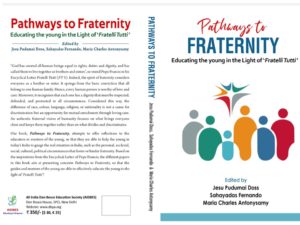
 Learning to Live Together: Achieving the Spirit of Fratelli Tutti through Service Learning
Abstract
In what is known as the “Delors Document of 1996,” UNESCO proposed four pillars of education in the 21st Century: Learning to know, learning to do, learning to be, and learning to live together. The aim of this chapter is to examine the similarity between the UNESCO document’s pillar of “learning to live together” and the spirit of Fratelli Tutti in building fraternity and social friendship among young people. Further, the chapter proposes “Service Learning” as a methodology of achieving the aims of UNESCO and Fratelli Tutti in the context of formal education.
The aim of the chapter is realised in three major sections and a strong conclusion. The three sections follow an adapted model of the pastoral cycle of […]
Publications
Publications
My Contribution to the 1st Uniservitate Global Symposium on Service Learning
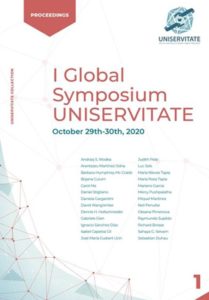 This volume dedicated to the I Global Symposium Uniservitate, compiles the reflections and experiences shared in the virtual event held in October 2020. The meeting aimed to facilitate the exchange between specialists, authorities and teachers of Higher Education institutions from different cultural contexts worldwide, around university social commitment and service-learning practices and programs.
My contribution was to:
Reflections on service-learning in the identity and mission of Catholic Higher Education. It was entitled, “Motivation for Social Transformation through Spirituality in Service-Learning”.
In summary, the reflection argued that:
The goal of Catholic Higher Education Institutions is to create competent graduates
who will be agents of social transformation.
This can be achieved through well-accompanied service-learning.
Service-learning becomes a lifestyle when coloured by a deep spirituality.
Spirituality has the potential to generate intrinsic motivation, which will sustain the
graduates in social transformation.
Reference:
Selvam, S.G. (2021). Motivation for social […]
Ethics of HIV/AIDS and Religion in Africa: A Systematic Literature Review
{{unknown}}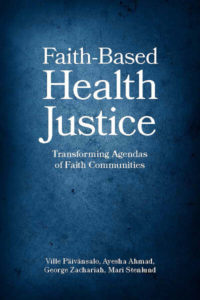 Ethics of HIV/AIDS and Religion in Africa: A Systematic Literature Review
Sahaya G. Selvam
Abstract
The role of religion in the prevalence and the prevention of HIV, and in the care of people living with HIV/AIDS and children orphaned by HIV, are well researched. The objective of the present systematic literature review was to examine the ethical issues underpinning the relationship between HIV/AIDS and religion in Africa. Carrying out a literature search in Academic Search Premier, a digital database of academic journals, 22 articles were selected based on some specific inclusion and exclusion criteria. The selected articles were analysed in order to identify patterns in the emerging themes related to the objective of the review. Three major themes were picked up. These include: Ethics of the influence of religion on behaviour related to HIV […]
Covid-19 tests self-learning skills of students today
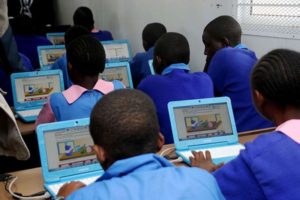 Covid-19 tests self-learning skills of students today
Sunday Nation, 26 April 2020
Covid-19 pandemic has challenged the status quo of the contemporary society on several fronts.
Its impact has been felt across almost every aspect of life, including healthcare services, economics, entertainment industry and sports, work and family life, and in religious and educational practices.
Amidst these global disruptions, the winners have been the contemporary twins, Information Technology (IT) and internet.
On the education front, the immediate focus has been on providing an emergency response, to keep the learning going remotely via the internet.
If our investment of resources right now just targets a stop gap measure, we might miss an opportunity to make a systemic change to education.
Covid-19 has thrust us by force, as it were, into how education ought to be carried out in the […]
My contribution to Sunday Nation, Kenya
{{unknown}}
26 April 2020
Covid-19 tests self-learning skills of students today
Covid-19 pandemic has challenged the status quo of the contemporary society on several fronts. Its impact has been felt across almost every aspect of life, including healthcare services, economics, entertainment industry and sports, work and family life, and in religious and educational practices. Amidst these global disruptions, the winners have been the contemporary twins, Information Technology (IT) and internet.
On the education front, the immediate focus has been on providing an emergency response, to keep the learning going remotely via the internet. If our investment of resources right now just targets a stop gap measure, we might miss an opportunity to make a systemic change to education. Covid-19 has thrust us by force, as it were, into how education ought to be […]